
Configuration Scheme of Industrial Planers on Cabinet Production Lines
The efficient operation of cabinet production lines relies heavily on the scientific configuration of industrial planers – which must match the precision standards of board processing, adapt to the production rhythm of different capacity scales, and also take into account cost control and long-term maintenance efficiency. Addressing the core needs of global distributors regarding “scenario adaptation, production capacity matching, precision assurance, and cost optimization,” this article will outline specific solutions based on the following four key points, providing a feasible planer configuration approach for cabinet production lines:
1. Core Requirements Analysis of Industrial Planers for Cabinet Production Lines (Precision, Efficiency, Adaptability, Stability)
2. Industrial Planer Model Selection Strategies for Different Production Capacities
3. Dedicated Supporting Configurations for Cabinet Processing: End-to-End Adaptation from Material Feeding to Dust Removal
4. Configuration Optimization Solutions: Cost Reduction, Efficiency Improvement, and Long-Term Maintenance Guarantee
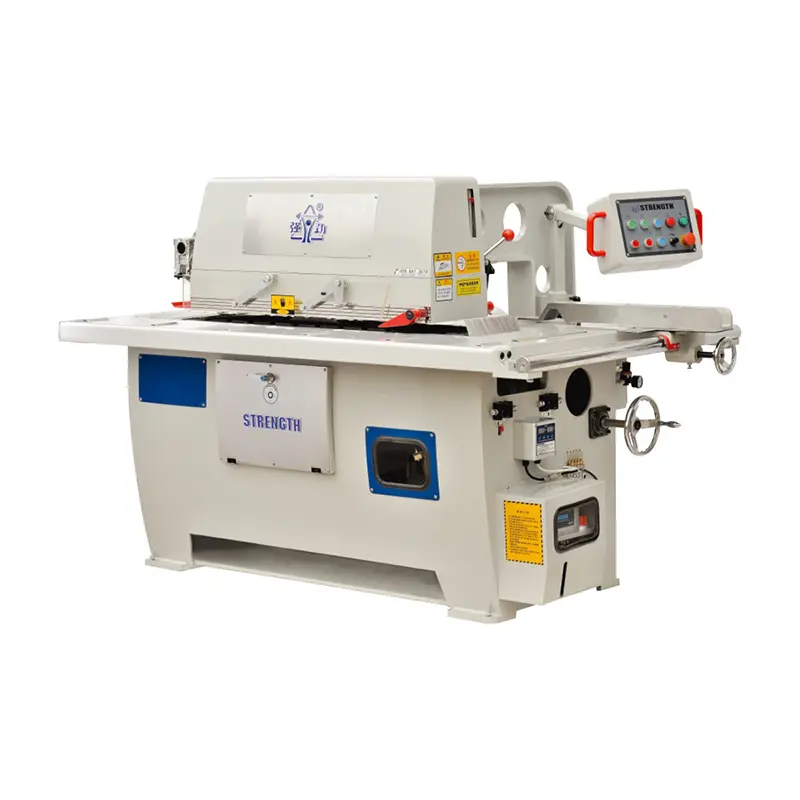
I. Core Requirements Analysis of Industrial Planers for Cabinet Production Lines
The unique nature of cabinet production dictates that industrial planers must meet four core requirements, forming the fundamental premise for configuration solutions:
Precision Requirements: The flatness error of the splicing surfaces and edge banding reference surfaces of cabinet panels (solid wood, particleboard, multi-layer board, etc.) must reach ±0.02mm; otherwise, it will lead to problems such as excessively large assembly gaps and edge banding detachment. The spindle runout accuracy and worktable parallelism of the planer directly affect the processing effect.
Efficiency Adaptability: From the daily production capacity of 50-100 sets in small and medium-sized cabinet factories to over 300 sets in large production lines, the planer’s processing speed (adjustable feed speed 0-20m/min) and continuous working time must match the overall production line rhythm to avoid bottleneck processes.
Board Material Compatibility: Cabinet production involves various types of boards, including softwood (pine), hardwood (oak), and engineered wood, which vary greatly in hardness and density. The planer needs to have adjustable cutting depth (0-10mm) and interchangeable tool types (high-speed steel tools, alloy tools) to meet the planing needs of different boards.
Stability Guarantee: Cabinet production lines are mostly continuous operations. The planer needs a high-strength machine body (cast iron bed preferred) and a well-ventilated spindle system to ensure 8-12 hours of continuous, trouble-free operation per day, minimizing downtime losses.
II. Industrial Planer Selection Strategies for Different Production Capacity Scales
The core of selection is “capacity matching,” avoiding “using a large machine for a small purpose” or “overloading a small machine.” Based on common production capacity scenarios for cabinet production lines, the following selection options are recommended:
1. Small to Medium-Sized Production Lines (Daily Capacity 50-100 sets)
Recommended Model: Single-Axis Woodworking Planer (Power 5.5-7.5kW)
Core Configuration: Worktable size 1200×400mm, spindle speed 3000-6000r/min, manual feeding + anti-rebound device
Advantages: Low investment cost (moderate unit price), simple operation, small footprint (machine size approximately 1800×1000×1500mm), suitable for small-batch, multi-style cabinet production, and flexible switching of board types.
2. Medium to Large-Sized Production Lines (Daily Capacity 100-300 sets)
Recommended Model: Dual-Axis Linkage Planer (Power 5.5-7.5kW) 11-15kW)
Core Configuration: Front-axis rough planer + rear-axis finish planer, adjustable feeding speed 5-15m/min, automatic table lifting (accuracy 0.01mm), hydraulic clamping device
Adaptation Advantages: Integrated rough and finish planing, improving processing efficiency by 40%, reducing secondary processing steps, suitable for mass production of standardized cabinet panels, and offering better stability than single-axis models.
3. Large-scale production line (daily capacity of over 300 sets)
Recommended Model: CNC fully automatic planer (power 18-22kW)
Core Configuration: PLC control system, servo motor drive, infinitely adjustable feeding speed 0-20m/min, automatic panel thickness detection, and integration with the production line (can be connected to panel saws and edge banding machines)
Adaptation Advantages: High degree of automation, requiring only 1-2 Manual operation, processing accuracy error ≤ ±0.01mm, suitable for large-scale standardized cabinet production, reducing labor costs and human error.
III. Specialized Supporting Configurations for Cabinet Processing: Full-Process Adaptation from Feeding to Dust Removal
The core performance of industrial planers relies on the synergy of supporting equipment. For cabinet production scenarios, the following supporting configurations are indispensable:
1. Feeding and Positioning Device
Recommended Configuration: Heavy-duty roller feeder (load capacity ≥ 50kg), with board straightening function to avoid processing deviations caused by board bending.
Special Requirements: When processing extra-long cabinet boards (e.g., 2.4m door panels), an extension worktable (expandable to 3m) is required to ensure stable support of the board throughout the process.
2. Cutting Tools and Cutting Aids
Cutting Tool Selection: For processing solid wood cabinets, alloy toothed cutting tools are recommended (high wear resistance); for processing engineered wood, high-speed steel spiral cutting tools are recommended (reduce edge chipping).
Auxiliary Configurations: Cutting tool cooling spray system (prevents board overheating and deformation), automatic chip removal device (prevents wood chip accumulation from affecting processing accuracy).
3. Dust Removal and Environmental Protection Configuration
Essential Configuration: High-efficiency dust removal interface (compatible with…) Φ120mm dust collection duct), linked to the workshop’s central dust collection system, dust collection efficiency ≥98%
Compliance Requirements: Meets EU CE and US EPA environmental standards, equipped with a dust explosion-proof device (for the flammable nature of wood chips), meeting the export compliance requirements of global distributors.
4. Safety Protection Devices
Core Configuration: Fully enclosed protective cover (transparent window for easy observation of processing status), emergency stop button (response time ≤0.1s), anti-rebound baffle (to prevent injury from rebounding wood).
Compatibility Standards: ISO 12100 mechanical safety certification, meeting the industrial safety standards of different countries and regions.
IV. Configuration Optimization Solution: Cost Reduction, Efficiency Improvement, and Long-Term Operation and Maintenance Guarantee
Reasonable configuration optimization not only improves production efficiency but also reduces overall costs, extends the planer’s lifespan, and creates long-term value for distributors’ customers:
1. Cost Optimization: Precise Matching, No Need for Over-Configuration
Avoiding Misconceptions: Small and medium-sized production lines do not need to blindly choose CNC models; single-axis or dual-axis models are sufficient, reducing initial investment.
Energy-Saving Configuration: Selecting variable frequency motors (reduced energy consumption) 20%), automatic power-off function in standby mode, reducing long-term operating costs.
2. Efficiency Optimization: Process Linkage and Parameter Adjustment
Production Line Linkage: When configuring large production lines, ensure the interface compatibility between the planer and the preceding panel cutter and subsequent edge banding machine to achieve automatic board flow.
Parameter Preset: For common cabinet boards (such as 18mm multi-layer board, 25mm solid wood door panel), preset cutting parameters (depth, speed) to reduce changeover and debugging time.
3. Operation and Maintenance Optimization: Reduced After-Sales and Maintenance Costs
Consumable Parts Configuration: Provide dealers with dedicated spare kits for vulnerable parts such as cutting tools and bearings for easy customer replacement.
Maintenance Design: Select models with simple machine structure and easy disassembly, equipped with a fault diagnosis system to reduce maintenance difficulty and extend service life (recommended whole machine warranty ≥1 year).
4. Customized Optimization: Adapts to special cabinet processing needs
Irregular Shape Processing: For curved cabinet doors, an adjustable curved surface planer attachment can be configured to expand the processing range
Multi-Size Adaptation: Equipped with replaceable workbench pads to meet the processing needs of cabinet panels of different thicknesses (5-50mm)
Post time: Nov-10-2025