
The Efficiency Advantages of Industrial Woodworking Planers Compared to Hand Planing
In the long history of woodworking, hand planing was a core skill passed down orally among craftsmen. A plane and a pair of skillful hands were all it took to carve a smooth, flat wood surface. However, with the rise of industrial production, the demand for output, precision, and cost control became increasingly urgent. Industrial woodworking planers, with their revolutionary efficiency advantages, have gradually become core equipment in modern woodworking workshops. Compared to hand planing, which relies on experience and physical strength, the efficiency improvement of industrial woodworking planers is not simply a matter of “faster speed,” but a systemic innovation throughout the entire processing flow.
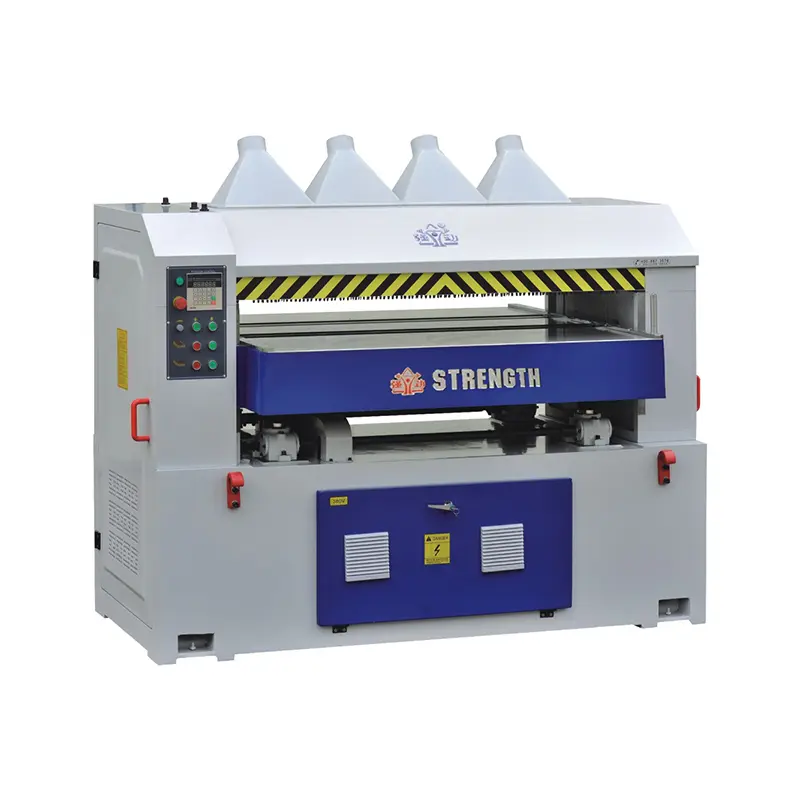
I. A Quantitative Leap in Speed: From “Single-Piece Time Consumption” to “Batch Output”
The efficiency of hand planing is essentially limited by the limits of human output. Even skilled craftsmen find it difficult to maintain high-intensity work for extended periods, and processing speed is directly linked to the material and size of the wood. Industrial woodworking planers, relying on mechanical power and automated feed systems, have achieved a breakthrough in processing speed, an advantage that is particularly significant in mass production.
From the perspective of single-piece processing cycle, a set of comparative data is sufficient to illustrate the difference: For a skilled craftsman using a traditional hand plane, it takes an average of 15 minutes to plan a 1-meter long, 0.5-meter wide, and 5-centimeter thick piece of mahogany. During this time, the planer blade needs to be adjusted multiple times to accommodate variations in the wood grain. In contrast, using a standard industrial planer, the same piece can be processed in just 2-3 minutes. Using a CNC planer can further increase efficiency by over 30%. This difference is even more pronounced in hardwood processing—hand planing hardwood requires significantly more physical effort and reduces speed by about 40%, while industrial planers, with their adjustable-speed cutter shafts and high-strength blades, can easily handle various types of hardwood, maintaining a relatively stable processing speed.
In terms of productivity per unit time, the advantage of industrial planers is overwhelming. A manual planer worker can only plan a maximum of 2 square meters per hour, and efficiency declines continuously with physical exertion. An industrial planer equipped with an automatic feeding system can plan 10-15 square meters per hour, with some large four-sided planers even exceeding 20 square meters. In standardized production scenarios, an industrial planer can produce 800-1200 standard boards per day (based on an 8-hour workday), equivalent to the combined daily output of 15-20 manual planing craftsmen.
II. The Hidden Efficiency of Consistency: Reduced Rework and Smooth Flow
The increased efficiency is not only reflected in faster processing but also in fewer errors. The precision of manual planing relies entirely on the craftsman’s feel and experience. Even with the same craftsman, workpieces processed at different times and under different conditions may exhibit flatness deviations and uneven thickness. This inconsistency directly leads to a surge in rework rates in subsequent processes (such as splicing and painting), slowing down the overall production pace and creating a dilemma of “visible speed, hidden slowness.”
Industrial woodworking planers, through precise mechanical control, fundamentally solve the consistency problem. Modern industrial planers are generally equipped with CNC systems and high-precision guideways, controlling the planing depth error within ±0.1 mm, and reducing the surface roughness Ra value by more than 50% compared to manual planing. Taking furniture production as an example, tabletops processed using industrial planers can directly enter the splicing process without additional sanding and finishing; while about 30% of hand-planed boards require secondary processing to meet splicing standards.
This consistency also provides a foundation for assembly line production. In large-scale woodworking workshops, industrial planers can work collaboratively with CNC saws, sanders, and other equipment. Processing parameters are transmitted synchronously through the system, and the entire process from cutting to planing to sanding requires no repeated manual adjustments to positioning. The smoothness of the production process is improved by more than 60% compared to the “manual-based” model.
III. Continuous Operation and Adaptability to Working Conditions: Overcoming the Limitations of Manpower and Scenario
The efficiency bottleneck of manual planing is also reflected in the continuity of work and adaptability to different scenarios. Physiological fatigue is a natural limitation—after one hour of continuous planing, a craftsman’s hand muscles will ache, efficiency will drop by more than 30%, and the effective working time per day is usually no more than 6 hours; moreover, for long, wide, or complex-grained wood, the difficulty of manual operation increases sharply, further reducing efficiency.
Industrial woodworking planers completely overcome these limitations. Firstly, in terms of continuous operation, modern industrial planers utilize high-strength bodies and wear-resistant cutting tools, enabling 24-hour uninterrupted operation with regular maintenance. Daily effective working time is more than three times that of manual work. Even when tool changes or parameter adjustments are needed, the process takes only 5-10 minutes, resulting in minimal downtime losses.
In terms of adaptability to working conditions, industrial planers offer even greater advantages. For solid wood profiles longer than 6 meters, manual planing can hardly guarantee straightness, while large gantry planers, through mechanical positioning and automatic feed, can complete the planing in one pass, controlling the accuracy error within 0.2 mm/m. For “difficult-to-process wood” with knots and diagonal grain, the intelligent feed system of industrial planers automatically adjusts the speed to prevent tool jamming. Manual planing in such situations not only significantly reduces efficiency but also easily leads to chipping and surface damage.
Furthermore, the automation level of industrial planers reduces reliance on manual labor. One worker can operate 2-3 CNC planers simultaneously and can be employed after a short training period; however, training a skilled manual planer often requires 1-2 years. Against the backdrop of continuously rising labor costs, this “reduced manpower, increased efficiency” advantage further amplifies the overall efficiency value of industrial planers.
IV. The Ultimate Transformation of Efficiency: Comprehensive Optimization from Production to Cost
The efficiency advantages of industrial woodworking planers ultimately translate into tangible cost optimization. In terms of labor costs, the investment in one industrial planer can replace more than 15 manual craftsmen. Based on an average hourly wage of 20 yuan, this translates to daily labor cost savings of over 2400 yuan, with the equipment investment typically recovering within 6-12 months.
In terms of material costs, manual planing achieves a wood utilization rate of approximately 75%, with a significant amount of wood wasted due to planing errors or damage; while industrial planers, through precise control of the planing amount, can increase wood utilization to over 90%. Based on processing 10 cubic meters of wood per day, an industrial planer can save nearly 100,000 yuan in wood costs annually.
More importantly, the improved delivery capabilities resulting from increased efficiency directly enhance market competitiveness. In the custom woodworking sector, companies using industrial planers can shorten order delivery cycles from 15-20 days to 5-7 days, and customer satisfaction and repurchase rates are more than 40% higher than companies relying on manual processing.
Conclusion: Value Reconstruction Behind Efficiency Innovation
The efficiency advantage of industrial woodworking planers compared to manual planing is not simply “machines replacing manual labor,” but rather a transformation in woodworking from “experience-driven” to “technology-driven.” Manual planing carries the warmth of traditional craftsmanship, while industrial planers provide the foundation for the large-scale and standardized development of the modern woodworking industry.
Post time: Dec-08-2025